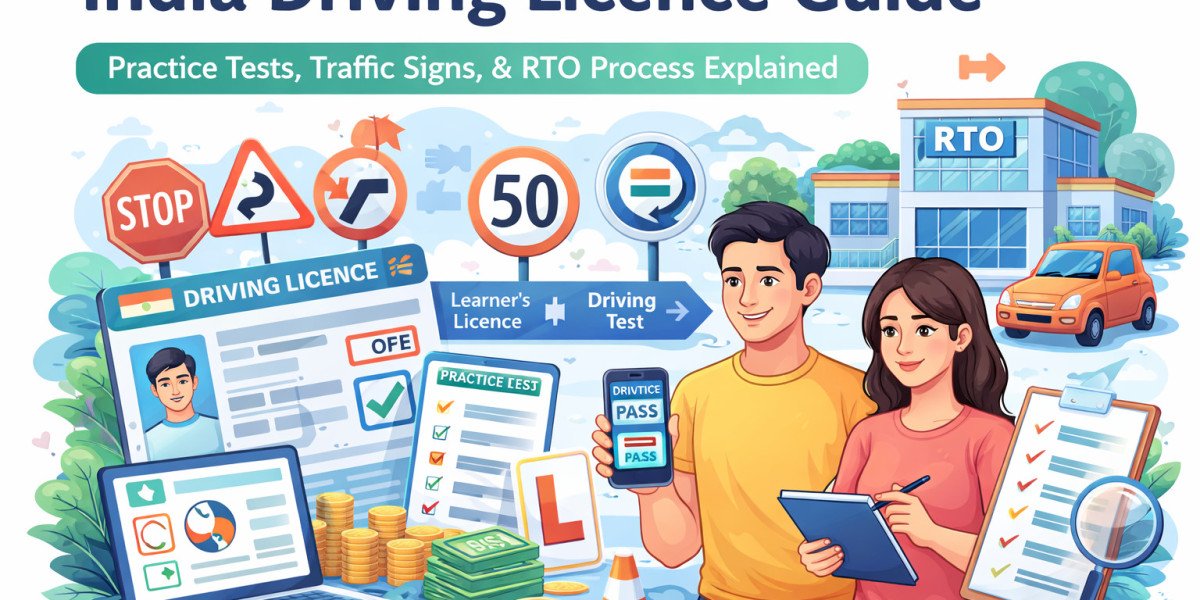

In India, acquiring a driver's licence is important to becoming a responsible motorist who follows the law. Whether you are new to driving or are trying to upgrade your current licence, you need to be familiar with how to obtain an Indian drivers licence, what the traffic laws are, and how to prepare for getting your licence. This complete guide has everything you need to compare including how to take an Indian drivers licence practice exam, what traffic signs mean, and the Drivers Licence in RTO Licence Processes.
Understanding the Driving Licence Process in India
Getting your driving license in India involves following the Regional Transport Office (RTO) procedures. The RTO manages your driver’s license, and getting your license involves two steps: getting your learner’s license and then applying for your driving license.
You obtain your learner’s license by taking a basic theory test, which tests your knowledge of the rules of the road, safety, and signs you will see while driving. Using a driving license practice test will give you a much higher chance to pass this test on your first attempt.
Your learner’s license is valid for a specific amount of time, and once you are eligible, you will be able to apply for your regular driver’s license by taking a practical driving test at the RTO.
Importance of Driving Licence Practice Tests
Success in all examinations relies on your ability to prepare for those exams; therefore, it's important to prepare well for the learner's licence examination. A driving licence practice exam allows you to become accustomed to the types of questions that you will face on the learner's licence examination. The practice tests created by driving exam schools mimic actual driving examinations in order to allow you to get familiar with all types of traffic regulations, laws, penalties, and signs.
If you take a driving licence practice examination every week, it will help you to find your weaker areas and give you more insight into the material on which you need to focus. These practice tests will also boost your confidence and decrease any anxiety related to taking the driving licence examination.
There are many online resources available to take practice tests that follow the most current guidelines set by your local Regional Transportation Office (RTO). Taking practice tests will help to make sure that you are prepared for your driving exam and also familiar with the most up-to-date traffic laws in your area.
Understanding Traffic Signs in India
Traffic signs play a vital role in maintaining road safety and smooth traffic flow. They are categorized into three main types: mandatory signs, cautionary signs, and informatory signs.
Mandatory signs indicate rules that must be followed, such as stop signs and speed limits.
Cautionary signs warn drivers about potential hazards like sharp turns or pedestrian crossings.
Informatory signs provide useful information, such as directions, distances, and facilities.
A clear understanding of these signs is essential for passing the learner’s test. Most questions in a driving licence practice test focus on identifying and interpreting traffic signs correctly.
Step-by-Step RTO Process
The RTO process may vary slightly from state to state, but the general procedure remains the same:
Apply for Learner’s Licence:
Submit the application online or at the RTO office along with necessary documents such as proof of identity, age, and address.Appear for the Learner’s Test:
This is a computer-based test that checks your knowledge of traffic rules. Preparing with a driving licence practice test can help you pass easily.Receive Learner’s Licence:
Once you pass the test, you will receive a learner’s licence, which is valid for a limited period.Practice Driving:
During this period, you must practice driving under supervision to gain confidence and skills.Apply for Permanent Licence:
After the required waiting period, you can apply for a permanent licence.Driving Test:
You will need to demonstrate your driving skills in front of an RTO अधिकारी. Proper preparation and understanding of road rules are essential.
Tips to Pass the Driving Licence Test
Passing the driving test requires both theoretical knowledge and practical skills. Here are some useful tips:
Practice regularly using a driving licence practice test to strengthen your understanding of rules and signs.
Pay close attention to traffic signs and road markings.
Follow all instructions during the driving test carefully.
Maintain confidence and avoid panic during the exam.
Ensure your vehicle handling skills are smooth and controlled.
Consistent preparation and practice will increase your chances of success.
Common Mistakes to Avoid
Many applicants fail the test due to simple mistakes. Avoid these common errors:
Ignoring traffic signs or misinterpreting them
Not preparing with a driving licence practice test
Lack of confidence during the practical test
Poor vehicle control or hesitation
Not following RTO guidelines
Being aware of these mistakes can help you perform better during the test.
Conclusion
In India, obtaining a driving licence requires adherence to the structured system of getting your driving licence and the preparation necessary to pass both the theory and the practical portions of the exam. Your chances will improve substantially by making sure that you know what the RTO procedures are, become knowledgeable about all traffic signs, and take as many practice tests for the driving test as you can.
The importance of a driving licence; however, goes beyond just being an official piece of paper. A driving licence is also a representation of responsibility. A driver must have safe driving practices, be aware of all laws related to driving, and continuously improve their driving ability in order to be a responsible and confident driver while on the roads of India.